Cape Verde: The Blue Sharks Making the World Check the Map
The World Cup story nobody can ignore
Every World Cup needs a team that makes neutral fans lean forward. At World Cup 2026, Cape Verde have become that team: a small island nation, a tournament debutant, and a side that has already made heavyweight opponents work far harder than expected.
Their 2026 campaign has turned the Blue Sharks into one of the tournament's great conversation starters. Draws against Spain and Uruguay have done more than add points to a group table. They have sent thousands of fans to search engines with the same question: where exactly is Cape Verde?
First geography trivia question: where is Cape Verde?
Cape Verde, officially also known as Cabo Verde, is an Atlantic archipelago off the west coast of Africa. It sits west of Senegal, out in the ocean rather than on the mainland. That single fact explains why so many people misplace it on a map: it is African by region, Atlantic by setting, and island-based in daily life.
Quick CapQuiz memory hook
Think: Cape Verde = west of West Africa. If you are looking at Senegal and then move your eyes into the Atlantic, you are in the right neighborhood.
Why this is a true minnow story
Cape Verde has a population of a little over half a million people and a land area of about 4,000 square kilometers. In World Cup terms, that is tiny. Many individual cities represented by other squads are larger than the entire country.
That scale is what makes the run so powerful. Cape Verde are not just a smaller football nation. They are a small country in almost every geographic sense: compact land area, scattered islands, limited player pool, and a huge diaspora that helps carry the story far beyond the archipelago.
The island facts hiding inside the football story
Cape Verde is made up of 10 main islands, usually grouped into northern and southern chains. The islands are volcanic in origin, and one of the easiest facts to remember is Fogo, whose name means fire in Portuguese and whose volcano gives the island one of the country's most dramatic landscapes.
- Capital: Praia, on the island of Santiago.
- Region: Atlantic Ocean, off West Africa.
- Highest point: Pico do Fogo, a volcano on Fogo Island.
- Language clue: Portuguese is the official language, reflecting Cape Verde's colonial history.
- Nickname: The national team are often called the Blue Sharks.
A flag that doubles as a geography lesson
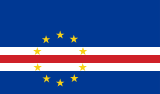
Cape Verde's flag is one of the more memorable ones once you connect it to the map. The blue field naturally fits an island country surrounded by Atlantic water, while the circle of stars points to the island group itself. The red, white, and blue bands give the flag a distinctive layout that is easy to pick out in a flag quiz.
For quiz players, the trick is to pair the flag with the setting: blue flag, Atlantic islands, west of Senegal. That is a much stronger memory than simply trying to memorize stripes and stars in isolation.
Why the World Cup run matters beyond football
For Cape Verdeans at home and in diaspora communities, this run is about recognition. World Cups are global map lessons. When a debutant holds its own against famous football nations, people learn the name, the flag, the capital, and the story behind the country.
That is the special power of a minnow run. It compresses sport, identity, and geography into one moment. Cape Verde's players are not only chasing a knockout place. They are making millions of people discover an Atlantic nation they may never have noticed before.
Mini quiz: Cape Verde edition
1. What is the capital of Cape Verde?
Praia.
2. Cape Verde lies off the coast of which part of Africa?
West Africa.
3. What is Fogo best known for?
Its volcano, Pico do Fogo.
4. What ocean surrounds Cape Verde?
The Atlantic Ocean.
5. What is the national team's nickname?
The Blue Sharks.
The takeaway
Cape Verde's World Cup 2026 story works because it is bigger than the scoreline. It is a reminder that a small country can create a huge sporting moment, and that football is often one of the best ways to learn the world map.
So the next time Cape Verde appear on a fixture list, do not just think underdog. Think Atlantic archipelago, Praia, Fogo, Blue Sharks, and one of the most enjoyable geography trivia stories of World Cup 2026.